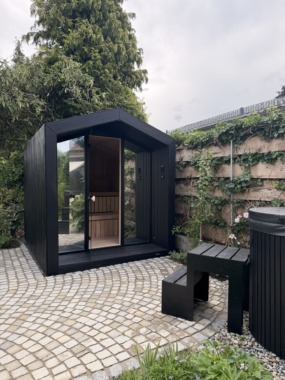
Installing a home sauna is often easier than people expect—but the electrical requirements need to be understood before the sauna arrives.
Depending on the sauna’s heater, you may need:
- A standard household power point
- A dedicated 15 amp power point
- A higher-capacity single-phase connection
- A hardwired electrical connection
- Three-phase power
The right setup depends on the sauna model, heater output, property and installation location.
For homeowners looking for a simpler option, the Celsium Ula Micro is supplied in Australia with a 3.5 kW plug-and-play heater and 15 amp plug. This means it can be connected to a suitable 15 amp power point without needing the heater to be permanently hardwired.
However, plug-and-play does not necessarily mean that no electrical preparation is required. Most Australian homes have standard 10 amp power points, so a licensed electrician may still need to install the correct 15 amp outlet before the sauna arrives.
Here is what Australian homeowners need to know.
The quick answer
The electrical requirements for a home sauna depend primarily on the output of its electric heater.
As a broad guide:
- Smaller infrared saunas may operate from a standard 10 amp outlet.
- Compact traditional saunas may use a dedicated 15 amp outlet.
- Medium and larger traditional saunas generally require a hardwired connection.
- High-output sauna heaters may require three-phase power.
The Ula Micro sits in a particularly convenient category. Its compact sauna room is designed around a 3.5 kW Harvia Vega Compact heater, allowing the Australian configuration to use a 15 amp plug-and-play connection. Celsium lists the Ula Micro’s recommended heater output as 3.5–4.5 kW and identifies its lower-output heater option as plug-and-play compatible.
This makes the Ula Micro an attractive choice for homeowners who want an authentic traditional stone sauna without automatically moving into a more complex hardwired or three-phase installation.
What does “plug-and-play sauna” actually mean?
A plug-and-play sauna arrives with an electrical plug designed to connect to a compatible power point.
For the Australian Ula Micro configuration, that is a 15 amp plug.
Once the correct outlet has been installed and checked, the sauna heater can be plugged into it rather than being permanently wired directly into the property’s electrical system.
This can make installation:
- Simpler
- Quicker
- Less disruptive
- Easier to plan
- Potentially less expensive than a larger hardwired installation
The term plug-and-play relates to how the sauna connects to the electricity supply. It does not mean that a 15 amp sauna can be connected to any existing household power point.
Is a 15 amp power point the same as a normal power point?
No.
Most ordinary Australian household power points are rated at 10 amps. A 15 amp power point is designed for equipment with a higher electrical demand.
Although the outlets look similar, a 15 amp plug has a larger earth pin and is designed to prevent it from being inserted into a standard 10 amp socket. Australian electrical manufacturers produce dedicated 15 amp, 250-volt plugs and matching outlets for higher-load appliances.
You should not:
- Modify the sauna plug
- File down or alter the earth pin
- Replace the plug yourself
- Use an unsuitable 10-to-15 amp adaptor
- Connect the sauna through an overloaded power board
If your property does not already have an appropriately located 15 amp outlet, a licensed electrician can assess and install one.
Does the Ula Micro need a dedicated 15 amp circuit?
The final circuit design must be determined by a licensed electrician after considering the sauna heater, existing switchboard, cable route and other loads on the property.
In most installations, it is sensible for a high-load appliance such as a traditional sauna heater to have an appropriately designed circuit rather than sharing capacity with several unrelated household appliances.
Your electrician should assess:
- Whether a suitable circuit already exists
- The distance between the switchboard and sauna
- The capacity of the existing switchboard
- Cable sizing
- Circuit protection
- RCD or safety-switch protection
- The proposed location of the outlet
- Exposure to rain or moisture
- Whether the outlet needs an appropriate weather-resistance rating
The goal is not simply to install a socket that physically accepts the plug. The complete electrical installation must be suitable for the heater and its environment.
Do I need an electrician for a plug-and-play sauna?
You do not need an electrician each time you plug in and use the Ula Micro.
However, you will need a licensed electrician if a new 15 amp power point, circuit or other fixed electrical work is required.
Australian states and territories regulate fixed electrical installation work. For example, Western Australian government guidance states that electrical work must be completed by someone holding the relevant electrical licence, while Queensland’s Electrical Safety Office warns homeowners against attempting to install or modify power points themselves.
In practical terms:
- Already have a suitable, compliant 15 amp outlet? Your electrician should confirm it is appropriate for the sauna and its location.
- Only have a standard 10 amp outlet? A licensed electrician will need to assess and install the required connection.
- Need to move or alter an outlet? This must be completed by a licensed electrician.
- Installing a larger hardwired sauna? The heater connection must be completed by a licensed electrician in accordance with its installation instructions.
After completing electrical work, the electrician should provide any certificate or compliance documentation required in your state or territory. In NSW, electrical contractors are required to provide a Certificate of Compliance for Electrical Work for applicable installations.
Where should the sauna power point be positioned?
The outlet location should be planned before the sauna base, landscaping or decking is completed.
Your electrician and sauna supplier should confirm:
- Where the power cable exits the sauna
- The length of the supplied cable
- Whether the outlet will sit behind, beside or near the sauna
- Whether it will remain accessible
- How it will be protected from weather
- Its distance from outdoor showers, pools, spas and other wet areas
- Whether the cable can reach without creating a trip hazard
Outdoor wiring systems must be designed to prevent water or moisture from causing the electrical system to fail. NSW government electrical guidance specifically notes that wiring used outdoors must be protected against water and moisture ingress.
The exact weatherproofing and outlet placement should be determined by the electrician. Avoid choosing the sauna’s final position and pouring a base before checking where the electrical connection needs to go.
Can I use an extension lead with the Ula Micro?
The preferred solution is to position an appropriately rated outlet so the sauna’s supplied cable can connect directly without relying on a temporary extension lead.
A sauna heater is a relatively high-load appliance and is often installed outdoors, where leads may also be exposed to moisture, heat, foot traffic or physical damage.
Australian electrical safety guidance warns that extension cords must be correctly rated for the connected appliance, fully unwound and kept away from situations where they could be splashed or fall into water.
Do not assume that an ordinary household extension lead is suitable for a 15 amp sauna.
Any proposed extension arrangement should be discussed with the sauna supplier and a licensed electrician. A correctly positioned permanent outlet is generally the cleaner and safer installation.
Does a home sauna need an RCD or safety switch?
RCDs—commonly called safety switches—are designed to disconnect electricity when potentially dangerous leakage to earth is detected.
The required circuit protection should be selected by the electrician in accordance with the current wiring rules, the heater instructions and the installation environment.
This is especially important for an outdoor sauna because electricity, weather and possible nearby wet areas need to be considered together. SafeWork NSW describes RCDs as devices that immediately disconnect the electricity supply when harmful leakage is detected.
The electrician may also need to consider:
- Circuit breakers
- Isolation requirements
- Earthing
- Cable protection
- Weatherproof fittings
- The position of controls and switches
- Clear access to the power point or isolator
Do not attempt to specify these components without professional electrical advice.
Does the Ula Micro require three-phase power?
The Australian 3.5 kW, 15 amp plug-and-play Ula Micro configuration does not require the homeowner to hardwire a large three-phase sauna heater.
It is intended to make traditional sauna ownership achievable for properties where a much larger electrical installation may not be practical.
A suitable 15 amp supply is still required, and the property must have sufficient electrical capacity. However, this is very different from installing one of Celsium’s larger sauna models with a higher-output heater.
This is a significant benefit for:
- Smaller Australian homes
- Courtyards
- Townhouses
- Urban backyards
- Holiday properties
- Home gyms
- Buyers who want to avoid unnecessarily complex electrical work
A homeowner should still have the proposed installation checked before ordering. Older homes, crowded switchboards and long cable runs may require additional electrical work even when the sauna itself uses a plug connection.
When does a sauna need three-phase power?
Three-phase power is more likely to be relevant when a sauna uses a larger, higher-output heater.
As sauna volume increases, more heating output is generally needed. Extensive glass, room dimensions, insulation and the desired heating performance can also influence heater selection.
For comparison, the current Celsium technical sheets recommend:
- Approximately 6 kW for the Ula Mini
- Approximately 9–11 kW for the Ula Classic and Ula Grand
Those product sheets identify three-phase requirements for the larger configurations.
Other Celsium models may use different heater types and outputs. Always check the exact sauna configuration rather than assuming its requirements based only on the number of seats.
What if my home does not have three-phase power?
Not every Australian home has three-phase power, and not every sauna needs it.
Begin by choosing the sauna model that suits your intended use and space. Celsium can then confirm the recommended heater and connection requirements for that configuration.
A licensed electrician can inspect your property and advise:
- Whether the proposed heater can operate on the existing supply
- Whether a new dedicated single-phase circuit is possible
- Whether the switchboard needs upgrading
- Whether three-phase power is already available
- Whether a three-phase upgrade is practical
- What work should be completed before delivery
For buyers hoping to minimise electrical complexity, the plug-and-play Ula Micro may be a more appropriate option than choosing a larger sauna and trying to redesign its electrical requirements afterwards.
Can solar panels power a home sauna?
A home with solar panels can offset some of the electricity consumed while the sauna operates, particularly when it is used while the solar system is generating power.
However, having solar panels does not change the sauna’s connection or electrical safety requirements.
The sauna still needs:
- The correct outlet or hardwired connection
- Suitable circuit protection
- Adequate switchboard capacity
- Compliance with the heater’s installation instructions
- Assessment by a licensed electrician
Battery capacity, inverter output, household demand and the time of use will determine how much of the sauna’s electricity is supplied by solar or stored energy.
Electrical planning checklist before ordering a sauna
Before confirming your sauna purchase:
- Choose the sauna model and heater configuration.
- Obtain the heater’s electrical specifications.
- Confirm whether it is plug-in or hardwired.
- Confirm whether it needs 10 amp, 15 amp, higher-capacity single-phase or three-phase power.
- Ask a licensed electrician to inspect the proposed location.
- Check the capacity and condition of the switchboard.
- Plan the cable route and outlet position.
- Confirm outdoor and wet-area requirements.
- Complete the electrical preparation before delivery.
- Retain the electrician’s compliance documentation.
Completing these steps early prevents delays and avoids positioning the sauna somewhere that makes the electrical installation unnecessarily difficult.
Frequently asked questions
Can a sauna plug into a normal Australian power point?
Some smaller saunas can use a normal 10 amp power point, but many traditional sauna heaters cannot. The electrical requirement depends on the exact model and heater.
The Ula Micro’s Australian plug-and-play configuration uses a 15 amp plug and therefore needs a compatible 15 amp outlet.
Can I plug a 15 amp sauna into a 10 amp outlet?
No. A 15 amp plug should not be modified or forced into a 10 amp outlet.
Have a licensed electrician install and test the correct connection.
Is the Ula Micro an infrared sauna?
The plug-and-play Ula Micro configuration uses a traditional electric sauna heater with sauna stones. Its simpler electrical connection does not mean it is limited to low-temperature infrared heating.
The 3.5 kW Harvia Vega Compact is designed for smaller sauna rooms and uses manual controls positioned on the heater.
Does plug-and-play mean no installation?
It means the heater connects through a plug rather than being permanently hardwired.
The sauna cabin still needs to be assembled or delivered assembled, placed on an appropriate level base and connected to a suitable 15 amp outlet. Electrical preparation may be required before delivery.
How much does it cost to install a 15 amp power point?
The cost varies according to the switchboard, cable distance, access, outdoor requirements and whether a new circuit is needed.
Obtain a site-specific quotation from a licensed electrician rather than relying on a generic allowance.
A simpler way to bring traditional sauna heat home
Electrical requirements should not be an afterthought when choosing a home sauna.
Larger saunas can require substantial electrical planning, but compact models can offer a simpler path.
Starting from $7,300, the Celsium Ula Micro combines a compact one-to-two-person design with a traditional 3.5 kW heater and Australian 15 amp plug-and-play connection.
Once the appropriate 15 amp outlet has been professionally installed and approved, the sauna can be connected without permanently hardwiring the heater.
It is an appealing solution for Australians who want:
- Traditional sauna heat
- A compact outdoor footprint
- Straightforward everyday operation
- Lower electrical complexity than a large-capacity sauna
- A premium European-designed sauna at home
Explore the Celsium Ula Micro or contact Celsium Australia to confirm the right sauna and electrical requirements for your property.
This article provides general information only and is not electrical advice. Requirements vary according to the sauna configuration, property, installation location and state or territory. Always follow the current product manual and engage an appropriately licensed electrician before installing or altering any electrical connection.